Have you ever found yourself looking at all those numbers in a marketing dashboard – impressions, clicks, followers, traffic, etc. – and wondering, “Alright, but is anything really happening here?” This is a problem that many business owners run into, because picking the right digital marketing performance metrics isn’t about the numbers, it’s about clarity.
Having spent many years working with clients on their e-commerce, local services, and business-to-business platforms, I have seen the same trend repeat itself over and over again. Businesses track the wrong information simply because they can measure it, but not necessarily because it’s useful. And the great thing about changing this is that it doesn’t take any new data.
Start With the Goal, Not the Metrics
The most significant error that companies commit is beginning with the metrics tab rather than the business goal. Before even inputting any numbers into your software, ask yourself one question: what do you actually want to get out of your marketing?
Is your objective:
Qualified leads
Sales
Branding
Website visits
Existing customers
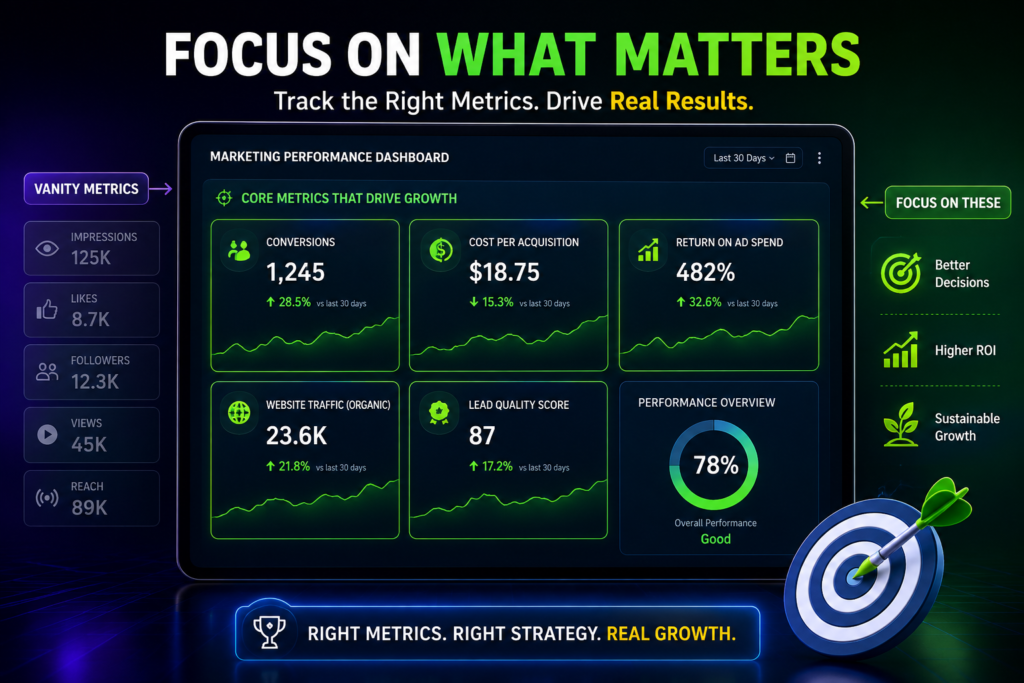
After you know this, it’s time to think backwards and choose metrics that directly align with this. This small adjustment will save you from falling into the single biggest mistake of digital marketing: getting lost in vanity metrics such as impressions and followers rather than actual revenue and qualified leads.
A Real Example: When “Good” Numbers Didn’t Mean Good Business
A few years back, I was working with a client whose primary goal was to drive traffic and social engagement on the site. In theory, the situation looked good as there were increasing numbers of both traffic and engagement in terms of likes. However, there was no significant number of inquiries and sales made by the company.
Thus, the focus changed from “how much traffic do we have on our site” to “how many of them are potential customers.” Changing just this question changed the entire approach. We figured out what channels could bring us leads, improved landing pages and call-to-actions, and limited traffic sources that provided us with good numbers but no results in terms of real business.
This case shows that any metric may look good while being of no help for your business growth at all. The key thing here is to select the metric that will make you make a better decision.
Different Businesses Need Different Metrics
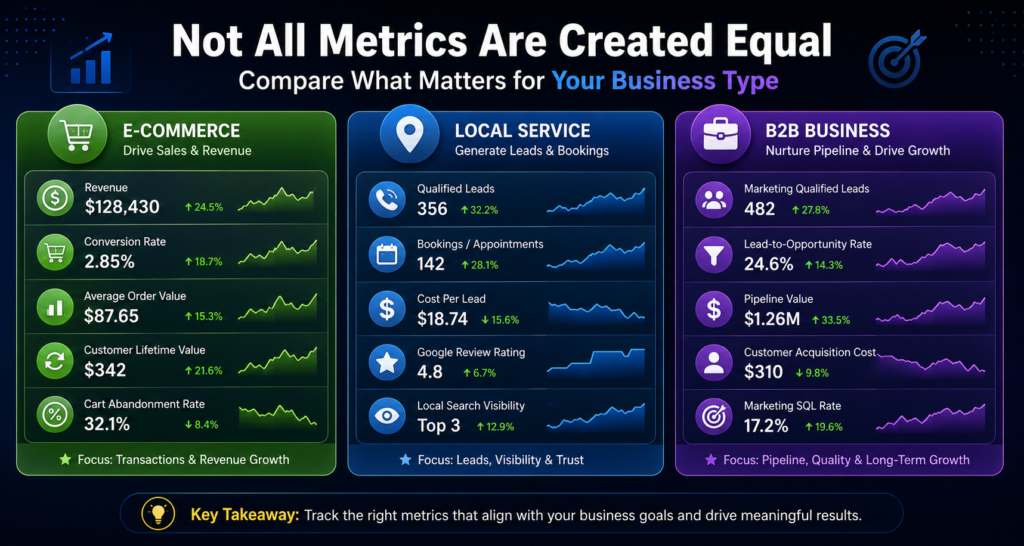
Not all organizations will have the same dashboard because the performance metrics will be based on the business model of an organization and the duration of the customer journey.
E-commerce
Conversion rate
People have the ability to purchase products directly from the website; therefore, the most relevant metrics include:
Average order value
Customer acquisition cost (CAC)
Return on ad spend (ROAS)
Revenue
Local services
Website traffic is not that useful in this case as long as it does not generate leads within the area. The most useful metrics are:
Qualified leads
Calls made
Booking rates
Cost per lead
Conversion rate of leads to customers
B2B companies
Since the sales cycle is typically longer, the metrics that matter will usually be lower down the funnel:
MQL (marketing qualified leads)
SQL (sales qualified leads)
Conversion rate from lead to customer
Value of pipeline
Revenue attributable to marketing
The first step is always the same: analyze the business model, the customer’s journey, and the main goal – and pick the metrics that will tell you if marketing is getting the company closer to the goal.
The Goal → Funnel → Metric → Action Framework
Eventually, I’ve learned a straightforward recipe I follow every time I start working with a new client. This works equally well if you are doing this on your own or delegating it to your marketing team.
Goal – What is the primary business objective? More revenue, leads, sales, bookings, or retention?
Funnel – In which stage of the funnel do customers get lost/gained by the company? Awareness, consideration, conversion, or retention?
Metric – Pick one-two key metrics for each relevant funnel stage rather than trying to monitor everything you can find.
Action – For every selected metric ask yourself, “If this number will increase/decrease, what decision will we make?” If there is no answer for a particular metric, it likely doesn’t belong on the main dashboard.
Review – Compare the performance against the past periods and business goals; adjust your dashboard as the business evolves.
Test this for yourself now: Write down your primary business goal and select three-to-five most relevant metrics. Remove any metric that you cannot explain or take an action based on.
The Biggest Mistake to Avoid
One of the most frequent errors is focusing on too many metrics without knowing which metrics really affect the achievement of the desired business result. This mistake is made quite often as it’s quite simple to count impressions, clicks, followers, reach, and ranking but it doesn’t mean that the collection of metrics will give insights.
The second mistake relates to analysis of metrics in isolation from other performance indicators. For example, it’s great to get many leads until it is found out that these leads are unqualified or not converted to customers.
My recommendation would be to choose no more than three to five key KPIs to focus on and relate them to particular business goals. The main aim here is not just to count some additional figures but to know what they mean and what should be done after.
FAQs
How many marketing metrics should a company measure? A company is better off measuring three to five primary metrics aligned with its key goal instead of a wide range of easily measurable metrics.
What is a vanity metric and what is a useful metric? A vanity metric is a number that is impressive but does not directly impact a business decision; for example, impressions or followers count. A useful metric is the metric which tells whether you need to revise the strategy; qualified leads, conversion rate are examples of useful metrics.
Should the e-commerce company and the B2B company measure the same metrics? No. E-commerce companies use conversion rate, average order value and ROAS, whereas B2B companies prefer MQLs, SQLs and pipeline value because of long sales cycle.
How frequently should marketing metrics be checked? A monthly evaluation comparing current period with previous period and goals is appropriate for most of companies, quarterly strategic review is recommended.
Final Thoughts
Selecting appropriate KPIs for digital marketing performance does not mean picking the best dashboard template; it means keeping focused on the business objective while letting go of numbers that will not lead to decision-making. Begin with the business objective, build your funnel, select a few KPIs that link both of them together, and always question what actions can be prompted by each number.