Table of Contents

When you have pondered on how to do keyword research for SEO without having to spend many months on researching the wrong keywords, there is no need to worry. The problem with most newbies is not that they lack tools when conducting keyword research. Rather, the problem is that most of them start at the wrong place – at the numbers rather than at the business.
From years of experience in developing keyword strategies for local service businesses and freelancers, I have seen a few mistakes keep repeating themselves. Solving those mistakes does not require any fancy software. Instead, what it takes is a shift in the way you view keyword research.
Mistake #1 in How to Do Keyword Research for SEO: Focusing on Search Volume Instead of Intent
This is probably the biggest mistake you’ll make as an SEO novice. You will fall into the trap of using search volume as your basis for selecting keywords. High search volume will mean more traffic and that means more business. This reasoning will be counterproductive.
A more appropriate set of keywords would be those with more specific buying intent, for example:
- Freelance Digital Marketing Strategist Kochi
- SEO Freelancer Kochi
- Digital Marketing Consultant Kochi
- Local SEO Services Kochi
Less visitors, but more chances of landing customers. In SEO, ten qualified visitors are worth more than one thousand who won’t convert to clients.
Example of how this trend plays out in practice: a local firm that has moved from using the general keyword “digital marketing” on its homepage to using more targeted keywords such as “SEO services in Kochi” and “Google Ads agency Kochi” can expect improved rankings, increased clicks, and better quality leads, even if they receive less traffic in total.
The Process Begins with the Business, Not the Keyword Tool
Here is a practical and reproducible approach:
- Start with understanding the business. Make sure you know the offers, the right customers, and the problems they are solving.
- Create seed keywords list manually. Start from writing down the main keywords manually such as “SEO services,” “Google Ads,” or “local SEO” before using any tool.
- Expand with keyword tools. Combine different sources instead of using just one tool.
- Analyze competitors. Look at what drives their traffic and the topics they have not yet covered.
- Look at the search intent. Type in the keyword and see if Google ranks blogs, services pages, or product pages.
- Cluster the keywords together. Create topical authority instead of creating pages randomly.
- Choose the keywords based on business value, not only volume.
- Create a content plan that will allocate keywords for service pages, blog posts.
Best Keyword Research Tools in 2026 (and How They Fit Together)
There is no silver bullet, which is why it helps to look at several top keyword research tools and analyze their data rather than depend on a single resource.
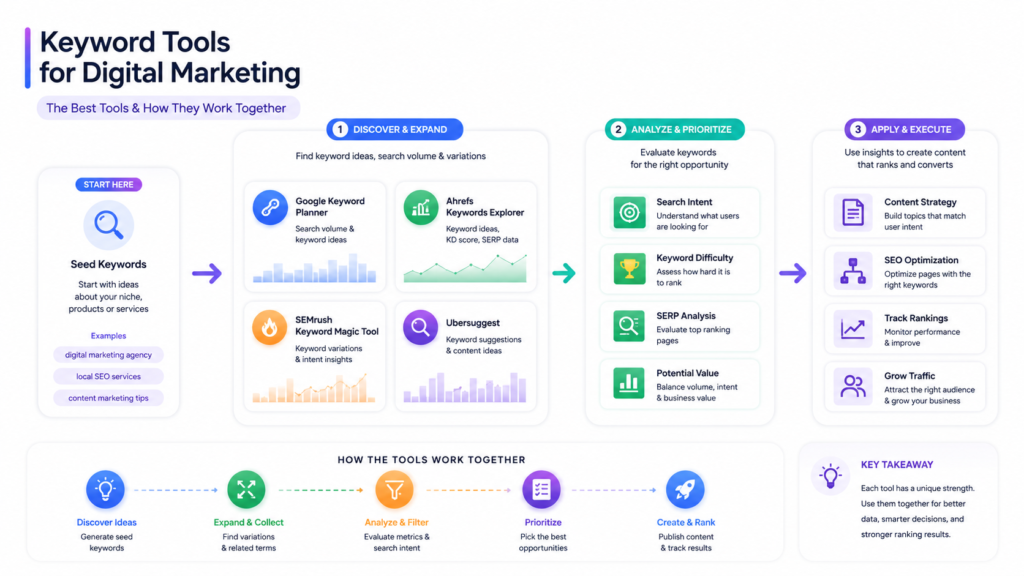
Google Search
User language, autocomplete suggestions, “People Also Ask”
Google Keyword Planner
Search volumes and commercial keywords
Google Search Console
Keywords an existing website already receives impressions for
Ahrefs / Semrush
Keyword difficulty, competitor rankings, traffic estimates
Google Sheets / Excel
Sorting and organizing the final keywords list
The most crucial component of this toolkit is not the tools themselves, but the ability to make decisions on the basis of business priorities and search intent and then test these decisions via available resources.
Mistake #2 in How to Do Keyword Research for SEO: Treating Tool Data as Fact Instead of Estimate
Every keyword tool — Ahrefs, Semrush, Google Keyword Planner, Moz — uses its own data sources and modeling. It’s normal for the same keyword to show different volumes or difficulty scores across platforms. The numbers are useful for comparison, not as exact measurements.
Ways this fails commonly:
Interpreting search volume as guaranteed traffic. A keyword with 10,000 searches per month will not drive 10,000 visitors. Position, CTR and SERP features like AI Overviews play into actual visitor numbers.
Disregarding search intent. “What is SEO?” will draw in students, while “SEO Consultant in Kochi” will draw in customers. The latter keyword has much more business value than the former despite lower volume.
Misinterpreting the importance of KD score. High KD scores may be overcome by good content and topical authority; Low KD scores might indicate an easy target, but only if there aren’t authoritative websites dominating SERPs.
Looking at each statistic separately. Volume, difficulty, intent and conversion potential should be analyzed together.
Failing to conduct a manual search. A manual search of the keyword can reveal a lot about it. What format is ranking, and what SERP features it has.
Relying on one tool being right. The methodology used will give a wide range of numbers from different tools.
Ask yourself not whether you should aim at something because of “it has 5,400 searches” but rather if it’s what your perfect customer is looking for and if you can make the best page for it.
One Thing to Do This Week
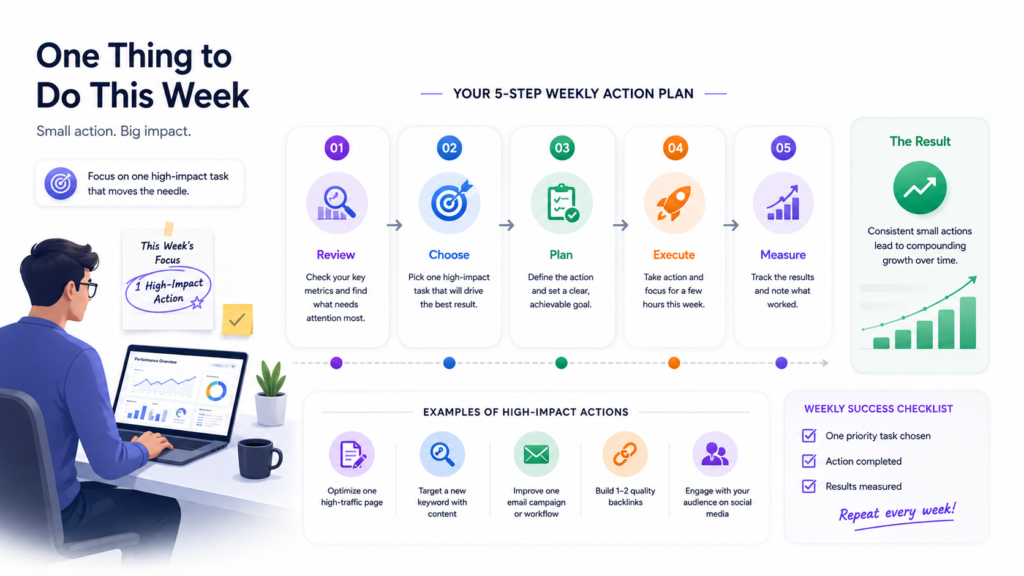
Out of all the things you can do after reading this, the one thing you should do is the following:
- Choose a page on your website and align it with one targeted keyword.
- Choose a page from your website or create one.
- Choose one main keyword for the page.
- Choose three to five secondary keywords which are relevant.
- Search the main keyword to know the user’s expectations and how Google sees it.
- Build/Modify the page to serve those expectations.
Instead of attempting to rank the homepage for “Digital Marketing,” “SEO,” “Google Ads,” and “Social Media Marketing” at once, create a page that revolves around one topic such as how to conduct keyword research for SEO and use some of the other related keywords in your content such as “best keyword research tools,” “competitor keyword research,” and “keyword research for beginners.”
FAQ
How long would keyword research take for my site? Well, it depends, of course, but the basic round of it – seeds, expansion by tools, competitive analysis, and clustering – can be done within a few hours per cluster, not weeks.
Do I have to use expensive tools such as Ahrefs and Semrush to conduct initial research? Not really. Google Search, Autocomplete and Google Keyword Planner will do just fine at this point. Paid tools become relevant only when you require competitive data.
What is the difference between search volume and search intent? The first one tells you how many people search the keyword. The second one tells you why they do so and what they expect to see. And this is much more important for conversions
In what ways does other competitor keyword research help in improving SEO? Competitor analysis enables one to identify keyword opportunities, know the content gaps, the ranking strategy, and the topics that interest your audience.
Conclusion
SEO keyword research is not just learning how to use another SEO tool, but learning how to tie your business objectives to your customers’ search intent. Stop trying to chase volume, recognize that tool numbers are only estimates, and construct your pages around clusters of keywords, not single keyword terms. Consistency will take you far beyond the sites trying to beat you on volume.